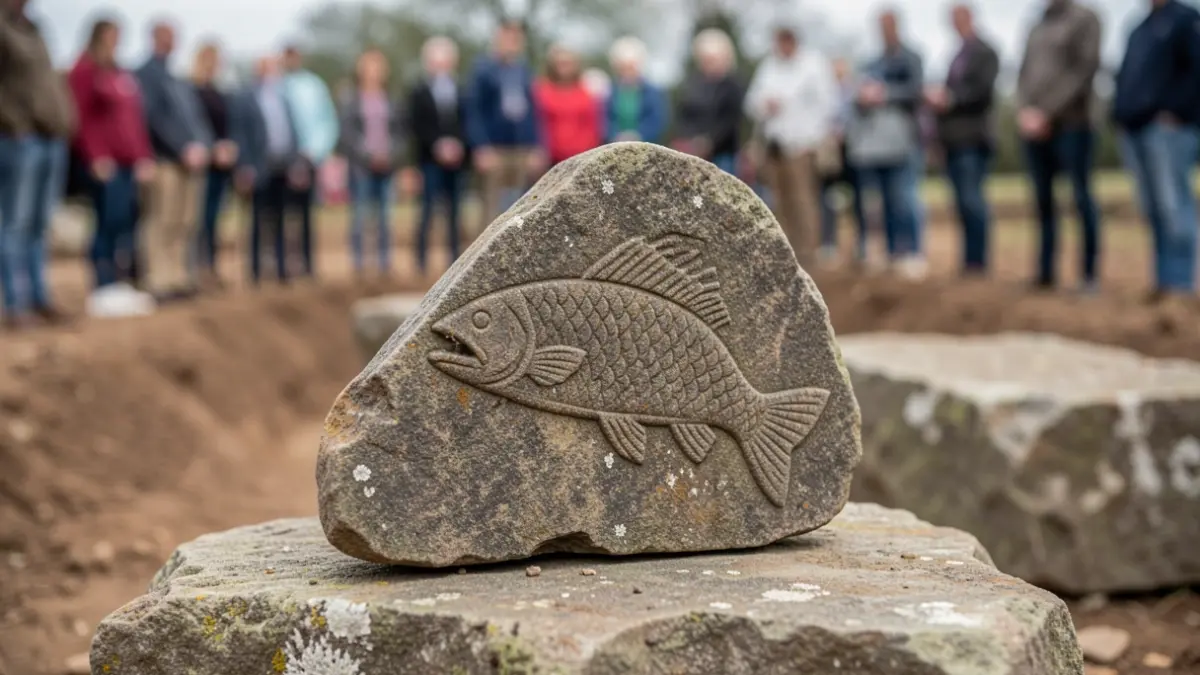
The excavation at Aberlemno III has revealed a fragment of an older Pictish stone bearing a salmon motif, a recognisable symbol in Pictish art, and a carved face in relief that may be Early Medieval in origin. These discoveries suggest that Aberlemno III, a site steeped in Scottish history, still holds many secrets.
The Pictish stone fragment, found propping up the base stone of Aberlemno III, features a salmon motif common on older Pictish stones in northern and eastern Scotland. Analysis is underway to determine when the stone fragment was incised and how it relates to the base stone's placement.
A separate carved head, found in the topsoil, appears unrelated to known Pictish monuments in the area and is believed to be Early Medieval. Its discovery hints at the potential for further carved monuments to be uncovered in Aberlemno.
Evidence found beneath the base stone suggests it may have been moved. One pit could indicate an earlier setting for Aberlemno III, potentially oriented towards Aberlemno Kirk. The stone may have later fallen or been moved, with the current base stone added and its orientation changed to the standard east-west Christian alignment.
“"The initial results of the excavation by AOC have already exceeded our expectations. The discovery of the Pictish stone fragment, as well as the carved head, give us new questions to answer."
“"We have learned that Aberlemno III has likely remained in its original location, but that it was moved or fell and the base stone was added later, while a piece of an older Pictish stone was used to prop it up. We are unsure how the head fits into this, and we are excited to start the next phase of post-excavation analysis and research to see how much more we can discover."
The base stone, with a section of Aberlemno III still embedded, has been moved to Edinburgh for further analysis, which is expected to reveal previously unseen carvings and provide deeper insight into the monument's history.
Historic Environment Scotland (HES), a charity dedicated to Scotland's historic environment, is leading the research. They thanked the Aberlemno community for their support during the excavation and pledged to continue sharing findings.