Scotland and the wider UK are positioning themselves as global leaders in the multi-billion-pound marine robotics sector, addressing the inherent risks and costs associated with offshore operations. The offshore environment, characterised by harsh weather and unpredictable sea conditions, presents significant challenges for human workers. With over 11,000 offshore wind assets in the UK and thousands more planned by 2050 to meet net-zero targets, the need for efficient, safe, and sustainable inspection and maintenance methods is paramount.
Traditional methods of inspecting and maintaining offshore infrastructure, such as wind turbines and subsea cables, require trained crews deployed on large support vessels. This approach, while effective, is resource-intensive, costly, and inherently risky. Maintenance alone can account for up to 30% of offshore wind farm operating expenses, driven by vessel fuel consumption, staffing, and logistical complexities. As the UK expands its offshore wind capacity, this method is increasingly seen as unsustainable due to its financial implications, emissions, and scalability limitations.
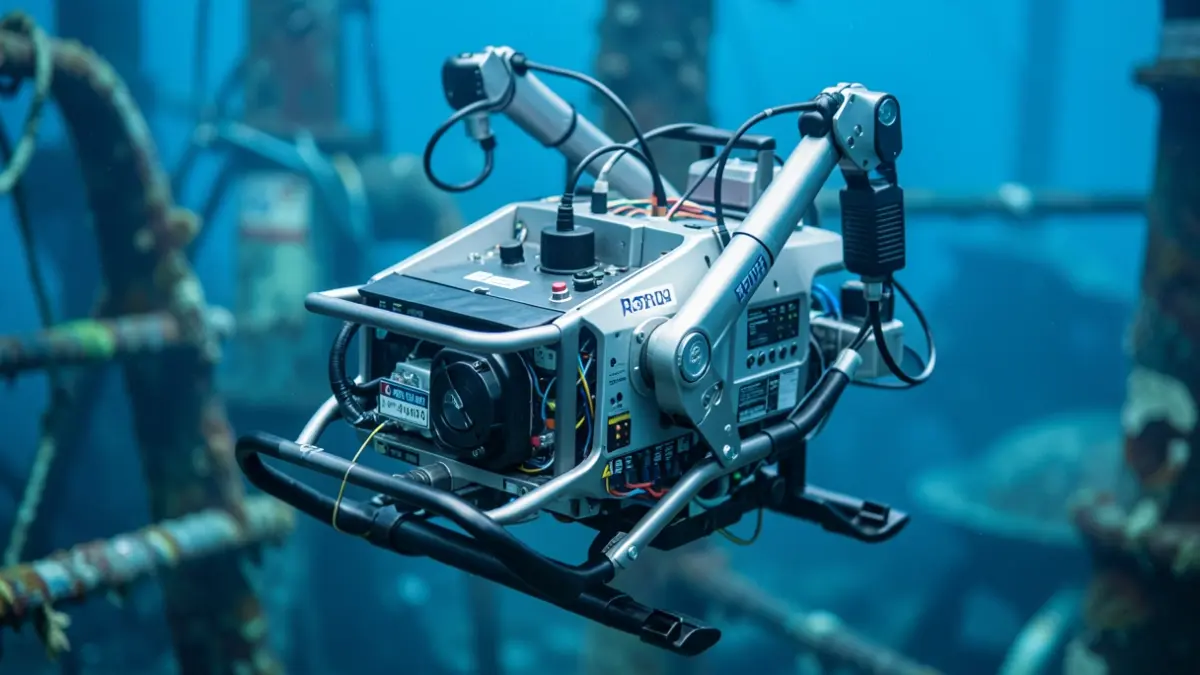
To tackle these challenges, The National Robotarium, a collaboration involving Heriot-Watt University, partnered with Fugro, a global leader in geo-data solutions, on the UNITE (Underwater Intervention for Offshore Renewable Energies) project. The project aims to develop advanced autonomous systems, particularly electric remotely operated vehicles (eROVs), to perform inspection, maintenance, and repair tasks underwater, offering a safer and more environmentally friendly alternative.
Since its inception in 2023, UNITE has made significant strides. Early trials at Heriot-Watt University’s Ocean Systems Lab in Edinburgh, within a controlled industrial wave tank, focused on parameters like speed, navigation accuracy, and data transmission reliability under simulated offshore conditions. Subsequent trials demonstrated considerable advancements in robotic perception and navigation. Utilising cutting-edge machine vision, the eROVs can generate detailed 3D maps and transmit real-time data even in low-visibility conditions, a major step towards autonomous operation in complex subsea environments.
The project also explored coordinated operations between multiple robotic systems, with trials showing tethered surface and subsea vehicles working in sync, adapting to obstacles, and dynamically repositioning. A key innovation is the robots' enhanced ability to understand their surroundings, identifying and classifying critical components like valves and pipes. This intelligent approach allows for earlier issue detection and more informed decision-making.
These advanced robotic solutions offer a compelling alternative to conventional methods, significantly reducing human intervention in hazardous conditions and improving operational efficiency. They also create new opportunities for skilled roles in robotics, such as pilots, operators, and data analysts, reshaping the offshore workforce towards high-tech operations.
The potential impact of eROVs is transformative. It is estimated they could reduce fuel consumption by up to 97%, from approximately 7,000 litres per day to just 200 litres. This not only offers substantial cost savings but also significantly cuts carbon emissions, supporting environmental and sustainability goals. These advancements pave the way for more frequent, cost-effective, and environmentally responsible monitoring of offshore assets, extending their operational lifespan and minimising the risk of environmental damage.
While UNITE's immediate focus is offshore wind, the technologies are applicable to oil and gas infrastructure, subsea pipelines, and decommissioning projects. The project provides a blueprint for university-industry collaboration to advance marine robotics in offshore operations, positioning Scotland and the UK as global leaders in the sector. UNITE was supported by £1.4 million in funding from the UKRI Engineering and Physical Sciences Research Council (EPSRC).